Desalination Pre-Treatment: Building Large-Scale Seawater Filter Lines
As global demand for fresh water continues to grow, seawater desalination has become one of the most important technologies for supplying clean drinking water and industrial process water. Countries facing water scarcity increasingly depend on large-scale desalination plants to convert seawater into safe, usable freshwater. However, the long-term performance of a desalination system depends heavily on the effectiveness of its pre-treatment process.
Seawater contains suspended solids, algae, microorganisms, organic matter, silt, and other contaminants that can foul reverse osmosis (RO) membranes. Without proper pre-treatment, membrane fouling leads to reduced water production, increased operating costs, higher energy consumption, and frequent maintenance.
Large-scale seawater filter lines are designed to remove these contaminants efficiently before water reaches the RO system. Producing reliable filter cartridges for desalination applications requires advanced manufacturing technologies, premium filtration materials, automated production equipment, and rigorous quality control.
This article explains the role of desalination pre-treatment, the design of large-scale seawater filter lines, the manufacturing process of industrial filter cartridges, and the production technologies that ensure consistent filtration performance.
The reverse osmosis membrane is the heart of a desalination plant, but it is also one of its most sensitive components. Protecting these membranes is essential for maintaining stable plant operation.
Effective pre-treatment provides several benefits:
- Removes suspended solids and fine particles
- Reduces biological fouling
- Minimizes membrane scaling
- Extends membrane service life
- Improves system recovery
- Lowers cleaning frequency
- Reduces operating costs
- Increases overall plant reliability
An efficient filtration system allows the RO membranes to operate under optimal conditions, maximizing freshwater production while minimizing downtime.
Modern desalination facilities use multiple filtration stages to progressively remove contaminants.
The first stage removes large debris such as:
- Seaweed
- Shell fragments
- Sand
- Floating materials
This stage protects downstream equipment from mechanical damage.
Multi-media filters remove medium-sized particles using layers of sand, anthracite, or other filtration media.
These filters significantly reduce turbidity before cartridge filtration.
High-performance pleated filter cartridges provide the final barrier before reverse osmosis membranes.
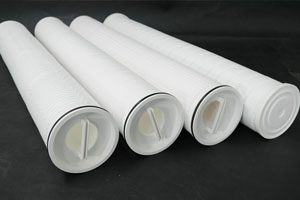
Typical filtration ratings include:
- 20 micron
- 10 micron
- 5 micron
- 1 micron
The selected micron rating depends on feedwater quality and plant design.
The performance of a seawater filter cartridge begins with selecting appropriate filtration materials.
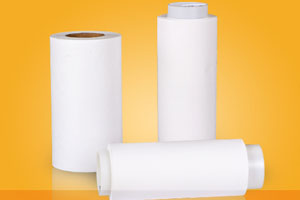
Polypropylene remains one of the most widely used materials because it offers:
- Excellent chemical resistance
- High dirt-holding capacity
- Low extractables
- Long service life
- Cost-effective operation
Glass fiber provides excellent pre-filtration performance and high contaminant retention for challenging seawater conditions.
Melt-blown polypropylene creates a depth filtration structure capable of capturing particles throughout the filter thickness, increasing contaminant capacity.
Producing industrial filter cartridges for desalination requires precision throughout every manufacturing stage.
Pleating increases the available filtration area while maintaining compact cartridge dimensions.
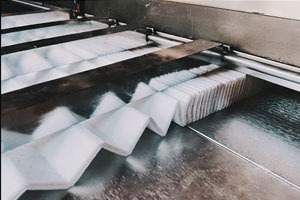
Benefits include:
- Higher flow rates
- Lower pressure drop
- Increased dirt-holding capacity
- Longer replacement intervals
Modern automatic pleating machines ensure consistent pleat spacing and uniform cartridge performance.
Pleated media must be cut accurately before assembly.
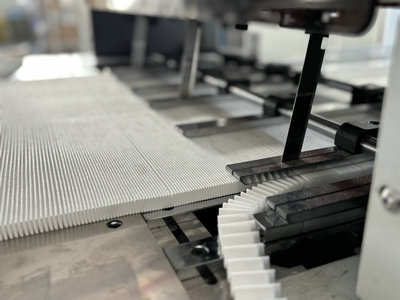
Automatic cutting systems deliver:
- Consistent lengths
- Smooth edges
- Reduced material waste
- Improved production efficiency
Precise dimensions are essential for reliable sealing and assembly.
The pleated media is welded into a cylindrical structure.
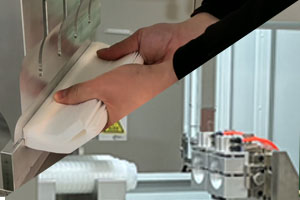
High-quality seam welding ensures:
- Leak-free construction
- Excellent mechanical strength
- Consistent cartridge geometry
- Reliable filtration integrity
Poor welding can create bypass channels that reduce filtration efficiency.
The connection between filter media and plastic end caps is one of the most critical manufacturing steps.
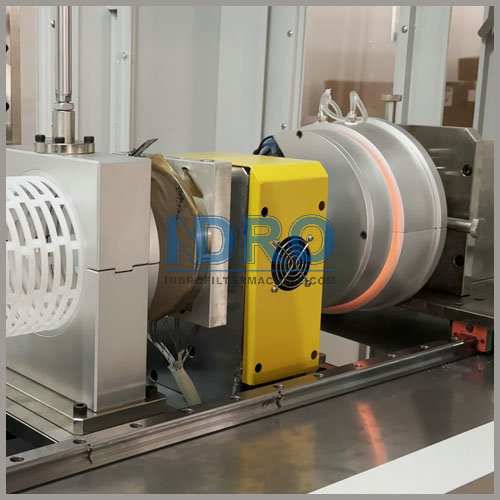
A weak weld can result in:
- Fluid bypass
- Cartridge leakage
- Premature failure
- Reduced filtration efficiency
Modern infrared welding technology has become a preferred solution for manufacturing premium pleated filter cartridges.
Compared with traditional hot plate heating, infrared welding offers:
- Non-contact heating
- Uniform temperature distribution
- Cleaner welding surfaces
- Improved weld strength
- Reduced material deformation
- Better production consistency
Advanced infrared heating systems equipped with water-cooling technology further improve process stability by maintaining consistent temperatures during continuous production. This innovative design minimizes overheating, reduces material sticking, and produces strong, reliable welds, making it an excellent choice for manufacturing high-quality desalination filter cartridges.
After welding, additional components are assembled.
Typical components include:
- Inner support core
- Outer protective cage
- Plastic end caps
- Adapters
- O-rings or sealing gaskets
Automated assembly equipment improves positioning accuracy and production efficiency while reducing manual errors.
Reliable desalination cartridges must perform consistently under demanding operating conditions.
Manufacturers conduct multiple inspections before shipment.
Operators verify:
- Pleat uniformity
- Weld appearance
- Component alignment
- Surface cleanliness
Critical dimensions include:
- Cartridge length
- Outside diameter
- Inside diameter
- End cap alignment
Pressure tests confirm structural integrity under operating conditions.
Flow testing verifies that cartridges meet required throughput without excessive pressure loss.
Filtration efficiency is evaluated to ensure the cartridge achieves its rated micron performance.
Industrial desalination cartridges must withstand pressure fluctuations without structural failure.
Modern manufacturing facilities increasingly rely on automated production lines.
Automation provides numerous advantages:
- Higher production capacity
- Stable product quality
- Lower labor costs
- Improved production efficiency
- Better traceability
- Reduced material waste
- Enhanced process control
Complete production lines typically include:
- Automatic media unwinding
- Pleating systems
- Precision cutting machines
- Seam welding equipment
- Infrared end cap welding machines
- Assembly stations
- Testing equipment
- Automatic packaging systems
Automation enables manufacturers to supply large volumes of filter cartridges for municipal desalination plants, industrial water treatment facilities, and offshore applications.
Large-scale seawater filter cartridges are also widely used in:
- Offshore oil and gas platforms
- Marine cooling water systems
- Power generation plants
- Coastal industrial facilities
- Shipboard water treatment systems
- Aquaculture operations
- Industrial process water treatment
These applications demand durable filter cartridges capable of operating continuously in corrosive and high-salinity environments.
As desalination capacity expands worldwide, filter cartridge manufacturers continue to innovate.
Emerging trends include:
- Higher-capacity pleated designs
- Low-pressure-drop filter media
- Longer service-life cartridges
- Smart production monitoring
- Automated quality inspection
- Energy-efficient manufacturing equipment
- Sustainable production practices
- Improved recyclable filter materials
These advancements help desalination plants reduce operating costs while improving water production efficiency.
Effective pre-treatment is the foundation of every successful seawater desalination plant. By removing suspended solids, biological contaminants, and fine particles before reverse osmosis, high-quality filter cartridges protect valuable membranes, improve operational efficiency, and reduce maintenance costs.
Producing these industrial filter cartridges requires premium filtration media, precision pleating, accurate cutting, reliable seam welding, advanced infrared end cap welding, and comprehensive quality testing. Automated manufacturing lines ensure every cartridge delivers consistent performance under demanding desalination conditions.
As global investment in desalination continues to grow, manufacturers equipped with advanced filter cartridge production technologies will play a vital role in supporting reliable freshwater production. High-performance seawater filter lines not only improve plant efficiency but also contribute to sustainable water resources for communities and industries around the world.